War, Honor, and the Clash of Two Mighty Realms
 Among the grand conflicts sung in the Darangen, none is as thunderous or as politically charged as the war between Bumbaran — the radiant kingdom of legendary heroes — and Kadaraan sa Kapatagan, a lowland realm known for its formidable warriors, fertile plains, and vast networks of alliances.
This is not a simple story of conquest.
It is a tale of pride, misinterpretation, prophecy, and the heavy cost of duty.
THE RISING OF TWO POWERS
In the old verses, Kadaraan sa Kapatagan is described as a kingdom of wide fields, guarded by warriors who moved as one — “like spears rising from the earth.” Its rulers, descended from ancient datus, were proud protectors of their land and traditions.
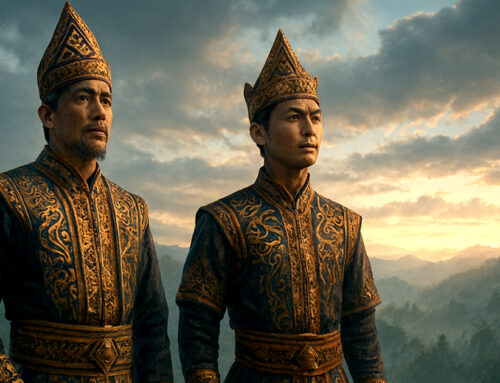
Meanwhile, Bumbaran, home of heroes like Bantugan and Mabaning, was a kingdom of shining torogans, its panolong carved with the histories of countless victories.
For generations, these two realms coexisted in respectful distance.
But epics remind us:
The greatest wars often start not from hatred, but from wounded honor.
THE SPARK OF CONFLICT
In most traditional versions, the conflict began with pagka-lipatan — a misunderstanding fueled by pride.
A royal gift meant for the datu of Kadaraan was delayed by emissaries of Bumbaran due to storms and bandits. The delay was misread as disrespect.
At the same time, envoys from Kadaraan arrived in Bumbaran during a festival — but the court, distracted by celebration, failed to receive them with the proper honors.
Another perceived insult.
Neither kingdom wished for war.
But both were bound by maratabat — that unyielding sense of dignity.
And when dignity is threatened, a datu cannot remain silent.
THE MUSTERING OF ARMIES
Kadaraan was the first to prepare.
Warriors from the plains assembled with shields painted in earth-tones, spears that glinted like lightning, and drums that echoed like approaching storms.
Bumbaran answered with its own champions — men who had faced monsters, crossed enchanted forests, and survived trials of the unseen world.
The Darangen says:
“When Bumbaran prepares for war, even the winds run ahead to warn distant hills.”
THE GREAT BATTLE OF THE PLAINS
The decisive confrontation happened on a vast open field where even the earth seemed to brace itself. The battle is often described in sweeping imagery:
⚔️ The Shield-Wall of Kadaraan
Kadaraan’s warriors formed a barrier so tight that arrows shattered before they touched the ground. Their discipline was unmatched.
⚔️ The Spear-Charge of Bumbaran
Bumbaran’s fighters advanced with the speed and ferocity of a storm wind, each warrior moving as though guided by an unseen rhythm.
⚔️ The Duel of Champions
In many tellings, a duel between Bumbaran’s prince (often Bantugan or one of his kin) and Kadaraan’s greatest warrior became the symbolic heart of the war.
Steel clashed.
The plains shook.
Both fighters earned each other’s respect — even as they sought victory for their people.
TURNING OF THE TIDE
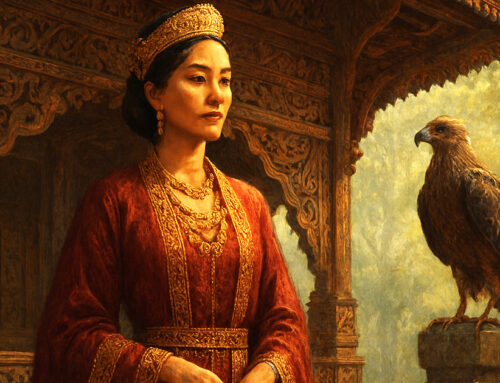
Legend says that at the height of the battle, a mysterious omen appeared — sometimes described as:
-
a great bird circling above,
-
or thunder splitting a clear sky,
-
or an unexpected stillness that silenced both armies.
The omen was interpreted in different ways, but its message was clear:
“This war will end at great cost if continued.”
And so the leaders hesitated.
Sometimes, this moment is led by a wise princess (Lawanen in some traditions), or by an elder datu who intervenes.
THE PEACE THAT COST MUCH
Negotiations followed — slow, tense, but possible.
Kadaraan demanded respect.
Bumbaran demanded clarity.
Ultimately, tribute and apologies were exchanged not as humiliation, but as symbolic offerings to restore balance.
Both kingdoms suffered losses, and both realized that honor could not be reclaimed by endless bloodshed.
THE LEGACY OF THE WAR
To this day, the war between Kadaraan sa Kapatagan and Bumbaran is remembered not just as a clash of arms, but as a reminder that:
-
Miscommunication can destroy nations.
-
Maratabat must be guided by wisdom.
-
Victory without justice brings no peace.
-
Even the strongest kingdoms must learn humility.
It is one of the Darangen’s most powerful lessons:
that greatness is not shown in how a kingdom fights, but in how it chooses to end a fight.